
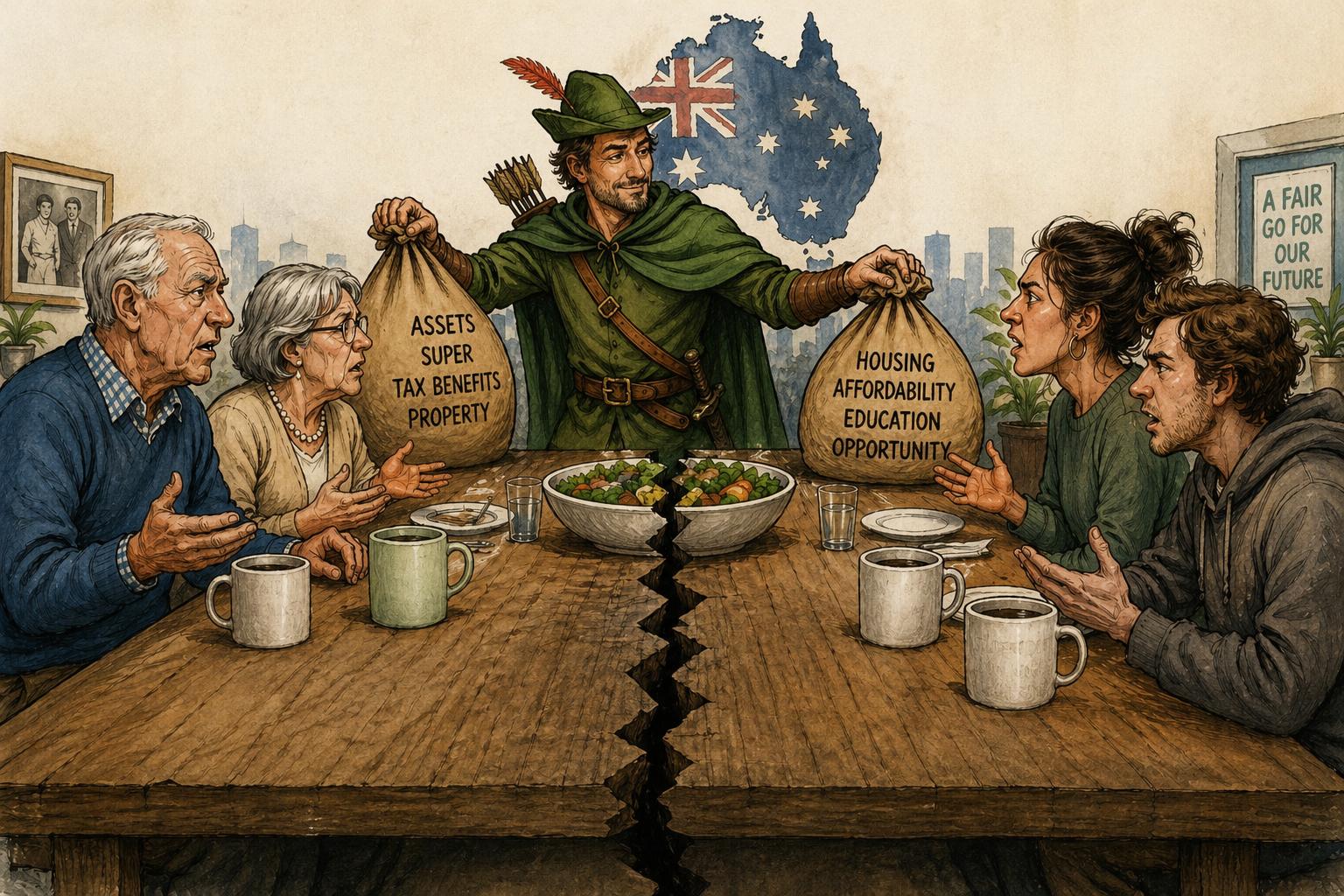
There is a strange Robin Hood process creeping through Australian politics. Not the old story of taking from the rich to help the poor, but something sharper and more personal: taking from one generation to pacify another.
Older Australians are told they have too much. Too much house, too much super, too much tax advantage, too much accumulated luck. Younger Australians are told they have been locked out before they even reached the door.
Both stories contain truth. That is what makes the argument dangerous.
The father looks at his house and sees forty years of work, debt, sacrifice and repair bills. The daughter looks at the same house and sees a ladder pulled up into the clouds. The mother sees superannuation as prudence. The son sees a protected store of wealth while his own rent rises faster than his wages.
And so politics walks into the family dining room.
A change to negative gearing is no longer just tax policy. It is an accusation. A debate about franking credits becomes a verdict on whether retirees are greedy or careful. A discussion about housing becomes a trial of the entire post-war settlement.
Families begin repeating the slogans of campaigns without noticing. One side says, “Your generation had it easy.” The other replies, “We worked for what we have.” Neither sentence is completely wrong. Neither sentence repairs anything.
The real failure is that governments have no honest national story for the transition. They do not say plainly that housing, health, taxation, wages and retirement are now locked together in one strained machine. Instead they tweak one lever at a time and let each group believe the other is the problem.
That is how a country becomes brittle. Not through one grand ideological battle, but through a thousand small resentments carried home from the news, repeated over dinner, and eventually mistaken for family truth.
The old Robin Hood tale worked because the villain was far away: the sheriff, the crown, the distant collector. But this new version has no clean villain. The supposed hoarder may be your father. The supposed burden may be your child.
Once politics reaches that point, fairness stops sounding generous. It starts sounding like a claim on someone else’s life.
Australia needs more than redistribution by resentment. It needs a settlement that lets the young begin without making the old feel hunted, and lets the old retire without pretending the young are merely impatient.
Until then, the rope will keep tightening. And the family table, once the place where generations explained the world to each other, will become just another front line.