
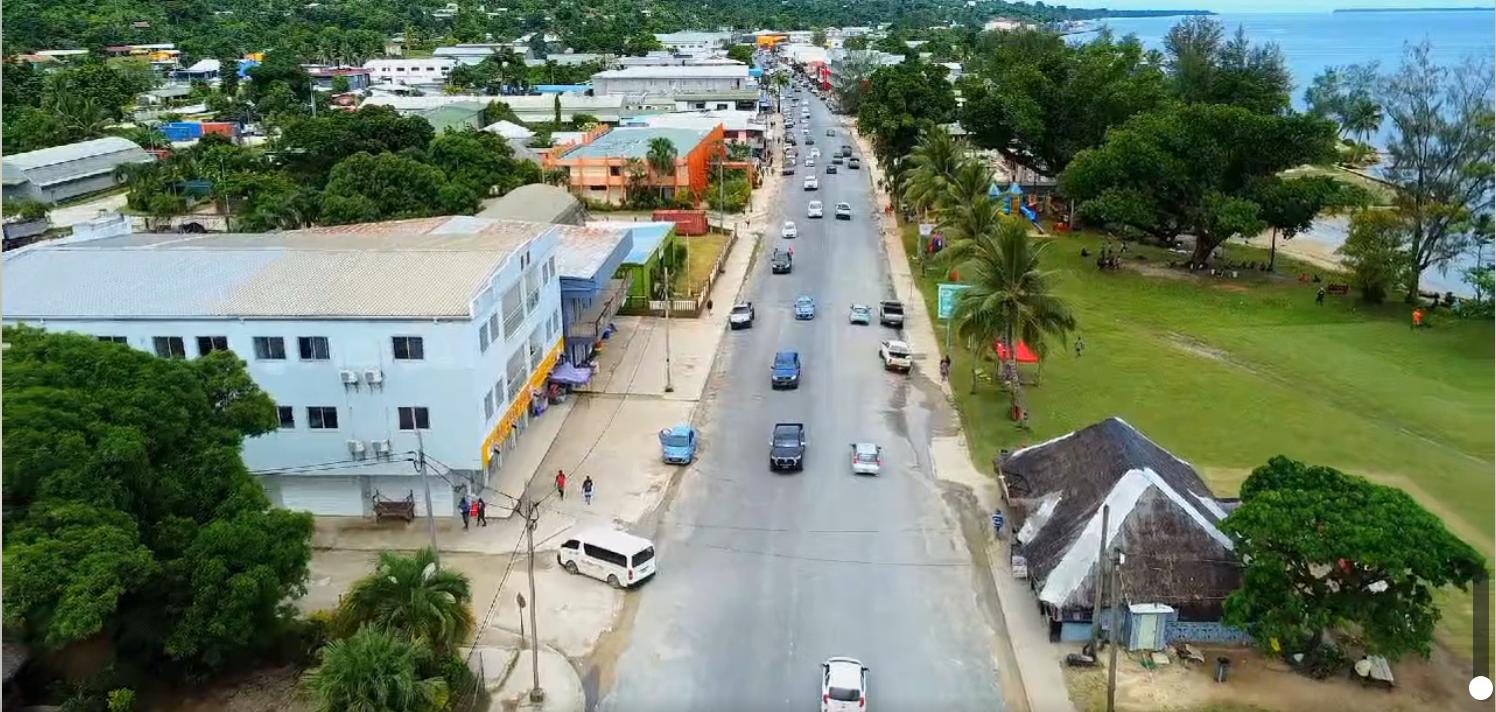
The buildings going up in Santo do not always look like businesses waiting for business. More often they look like positions already taken — structures built not for today’s customer, but for tomorrow’s circumstance.
Concrete Without Commerce
Walk the road in Santo and look around.
Concrete buildings rise where trade does not. Wide shopfronts open to quiet streets. Upper floors are finished, locked, and waiting. Lights are off. Doors are shut. Yet the power meters still turn for no clear reason.
Locals ask the obvious question: how do these places make money?
The answer may be simpler than people think. They do not. At least not here. Not in the ordinary sense.
Cheap goods cannot pay for expensive concrete. A small town cannot feed oversized commercial blocks. Electricity alone can ruin the arithmetic.
So the first thing to understand is this: these buildings are not really businesses.
Presence Disguised as Trade
They are positions.
Money has been turned into presence. Presence has been turned into patience. Patience has been turned into options.
In that light, empty space is not a mistake. It is flexibility.
A shop that barely trades is not necessarily a failure. It may simply be cover. The building itself is the product. The value lies in being there, being visible, being ready, and being able to wait.
Why Santo?
Because Santo is quiet. Because Santo is tolerant. Because Santo sits far enough from power to avoid scrutiny, yet close enough to ports to matter. Because Santo asks fewer questions than places that imagine themselves at the centre of the map.
Santo does not need to grow quickly for such a strategy to work. It only needs to remain open.
And in an uncertain world, openness has a value all of its own.
The Road and What Roads Really Do
Now look at the road.
A climate-resilient road, paid for with borrowed money, can be defended in all the usual ways. It helps families. It helps farmers. It helps ambulances. All of that may be perfectly true.
But roads do something else as well.
They turn distance into price. They turn bush into access. They turn forests into something negotiable.
A bad road protects land by accident. A good road makes land discussable.
The Soft Loan That Is Still a Loan
Vanuatu did not pay cash for that road. No small island country really does.
The money came as a loan. A soft loan. A long loan. A polite loan.
But still a loan.
As long as repayments are manageable, everything feels civilised. Debt only shows its teeth when the weather turns, when tourism drops, when revenue tightens, and when due dates remain perfectly punctual even as the country’s income does not.
Where the Money Really Goes
There is another part most people do not see.
The money that arrived did not stay in Vanuatu for long. It moved from the lender to the government, then to the contractor, then into machines, imported equipment, foreign crews, and supply chains that often lead back to where the contractor came from.
China built. China invoiced. China was paid.
Vanuatu kept the road. Vanuatu kept the debt.
This is not a dramatic conspiracy. It is simply how big infrastructure often works. But the result is a loop that should not be ignored:
Money is borrowed here. Profit leaves. Obligations remain.
When Pressure Arrives
Then comes the year when things tighten.
A cyclone season bites. Visitor numbers fall. Government revenue weakens. Loan payments continue with disciplined indifference.
The lender does not need to shout. It only needs to stop extending the tap.
Projects slow. Confidence softens. Government begins to need money quickly.
Why the Empty Buildings Matter
This is where the empty buildings return to the story.
The people behind them do not need to move fast. They are not scrambling for position. They are already positioned.
They do not need to threaten. They do not need to issue dramatic ultimatums. They simply wait for the moment when someone in authority begins to say:
“We need revenue.”
“We need jobs.”
“We need certainty.”
Then comes the offer. Not a threat. Never phrased that way.
A longer lease.
A wider concession.
A faster approval.
A softer boundary.
A forest now described as “under-used.”
No one says, “debt for timber.”
They say, “development.”
The Quiet Trade
The road makes it possible. The debt makes it urgent. The empty buildings make it feel normal.
Nothing is seized by force. Something is simply traded.
Time. Control. Future choice.
What Was Not Built
Now consider what was not built.
For the cost of such a road, Vanuatu might have bought aircraft. Not glamorous aircraft. Not vanity aircraft. Sensible turboprops that connect islands, move people, bring in business, and keep the nation visible to itself and to others.
Planes generate revenue. Planes attract movement. Planes invite scrutiny.
Planes also bring journalists, analysts, and critics.
Planes bring people like Denton Wilde.
Roads Move Goods. Planes Move Attention
Without planes, Santo stays quiet.
A road moves goods in and out. A road does not bring much attention. A road helps extraction. A plane makes ideas travel faster.
So Santo remains the Cinderella island — useful, presentable, and largely unnoticed.
Dressed well enough to host others. Never quite invited to the ball.
The Buildings Are Waiting
The buildings do not wait for customers.
They wait for circumstances.
The road is not only about resilience. It is about readiness.
The absence of planes is not merely bad planning. It may also be silence by convenience.
And silence, in places like this, has value.
The Simple Truth
When borrowed money builds assets that send profits away, the future is being shaped quietly.
When a country chooses roads over wings, movement begins to happen on someone else’s terms.
And when a place stays quiet long enough, other people start deciding what that place is for.
Empty buildings do not mean empty plans.
They mean the story is being written somewhere else — while Santo is asked, politely, to keep the lights off.