
Every new technology begins with a promise.
It arrives wrapped in incentives, subsidies, and enthusiastic messaging about how much better life will become. The early adopters are rewarded. The system is designed to look attractive, convenient, even inevitable.
But there is a quiet economic rule that often goes unnoticed:
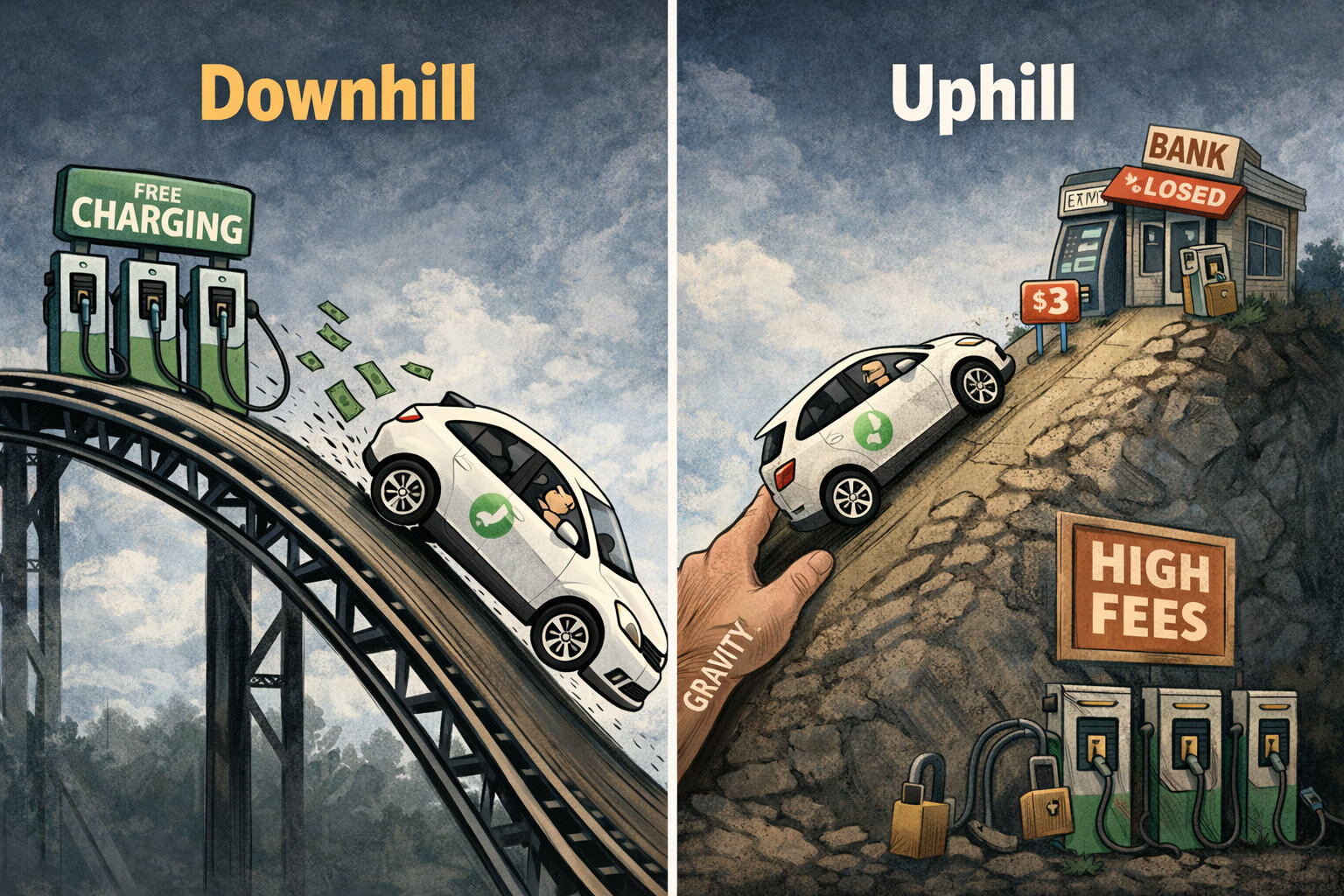
Gravity helps you going downhill. It never helps you going back up.
Electric vehicles may be the latest example.
The ATM Lesson
Think back to banking.
Once upon a time, if you wanted cash you walked into a bank branch. A teller handed it to you. No fee.
Then banks introduced ATMs.
They were sold as a convenience — machines that allowed customers to withdraw money anytime. At first they were free, an added service that made life easier.
But something subtle happened.
Branches started closing. Tellers disappeared. Suddenly the machine that once saved you time became the only option — and now the withdrawal came with a fee.
The system had rolled downhill.
And gravity does not reverse.
The EV Honeymoon
Electric vehicles today are still in their honeymoon phase.
Governments subsidise the cars. Charging stations appear in premium parking spots. Electricity for charging is often discounted or bundled with promotional programs.
In some places, early adopters even charge their vehicles for free.
That is the downhill run.
It is the stage where the system is being built, and where adoption must be encouraged.
But incentives are temporary.
They are not the business model — they are the marketing.
When Dependency Arrives
The real shift happens when the system becomes essential.
Once enough drivers rely on electric vehicles, the infrastructure becomes unavoidable: charging networks, grid upgrades, demand pricing, and subscription access.
That is when the economics change.
Charging stations are not charities.
Grid capacity is not infinite.
Investors expect returns.
So pricing structures appear.
Peak-hour electricity pricing.
Charging network membership fees.
Per-minute parking charges while plugged in.
Higher electricity tariffs for fast charging.
The system slowly evolves from cheap convenience to metered infrastructure.
Just like ATMs.
The Battery Question
There is another form of gravity built into EV ownership: batteries.
An electric vehicle’s most expensive component is also its most fragile asset. Batteries degrade with time, temperature, and usage.
In the early years, warranties make the issue invisible.
But warranties expire.
Replacing a battery pack can cost as much as a small car. And unlike an engine rebuild, it is rarely gradual — it is a large, sudden expense.
Gravity again.
The Infrastructure Lock-In
Petrol stations are decentralised. Thousands of independent operators compete with each other.
Electric mobility concentrates power in fewer places: utilities, grid operators, and charging networks.
That concentration creates a different kind of market — one where pricing can be more controlled and less transparent.
When mobility depends on electricity, transport becomes tied directly to energy policy, grid pricing, and infrastructure investment.
The road itself hasn’t changed.
But the economics of using it have.
The Downhill Advantage
None of this means electric vehicles are inherently bad technology. Electric motors are efficient. Maintenance can be simpler. Cities benefit from reduced local emissions.
But the economics of new systems follow familiar patterns.
At the beginning, gravity helps.
Subsidies, incentives, and free infrastructure make the transition feel effortless — like a roller coaster descending a hill.
Later, when the infrastructure is fully built and dependency has formed, the climb begins.
And gravity stops helping.
Because gravity, in economics as in physics, is always your friend in only one direction.