
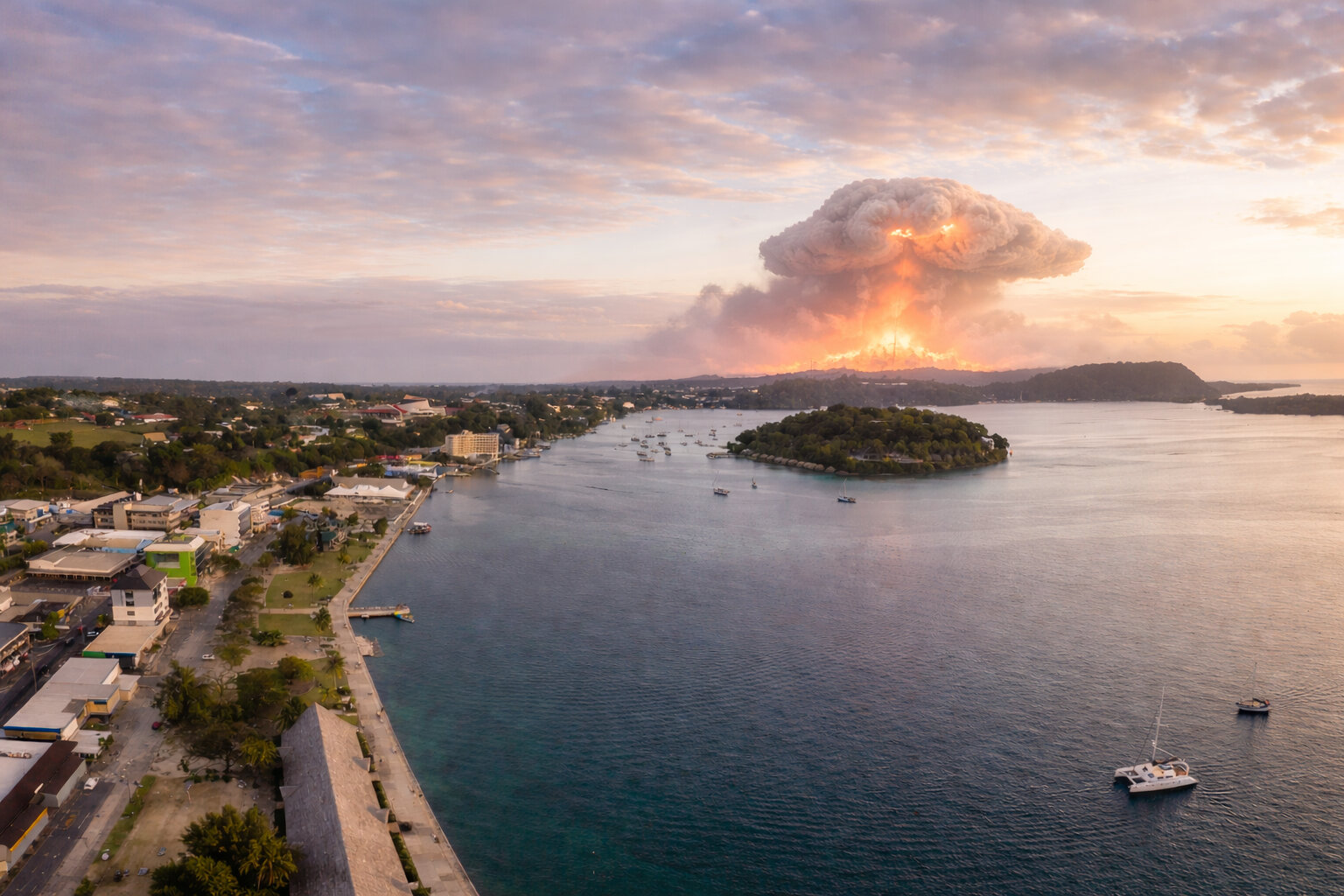
You can stand on the edge of Port Vila harbour at sunset and feel very far from Tehran.
The water is warm. The air smells of salt and diesel and frangipani. A cargo ship sits heavy at anchor, patient as a cow. Children jump off the seawall. Somewhere a radio plays old reggae through a cracked speaker.
It feels distant.
It feels insulated.
It feels like whatever is happening in the Persian Gulf belongs to another planet.
That feeling is a lie.
When tremors run through the Middle East — whether it is the tightening grip of Ayatollah Ali Khamenei or the potential fracturing of the system he built — the first reaction in places like Vanuatu is a shrug.
“Hemia longwe tumas.”
It’s too far away.
But distance in 2026 is measured less in kilometres and more in shipping routes.
A missile in the Strait of Hormuz does not need to land in the Pacific to change life here. It only needs to make insurers nervous. It only needs to lift the price of oil by ten dollars a barrel. It only needs to spook currency markets for a week.
And suddenly:
- The diesel for the inter-island boat costs more.
- The freight container of rice costs more.
- The builder’s cement costs more.
- The airfare from Brisbane ticks upward.
No explosion in Vila.
No sirens in Santo.
Just a quiet adjustment in the invoice column.
That is how global conflict reaches the islands — not with fire, but with percentages.
There is another illusion at play.
We like to think small nations are outside the gravity of superpower tension. That neutrality is a shield. That remoteness equals safety.
Remoteness equals vulnerability of a different kind.
Vanuatu imports its fuel.
It imports much of its food.
It imports construction materials.
It imports aircraft parts.
Every one of those imports floats across oceans tied to insurance markets and oil benchmarks that are decided far from our reefs.
When leadership stability in Iran wobbles, the price of Brent crude does not ask whether you live in Shefa Province or Sydney. It simply moves.
And yet — here is the paradox.
In moments of global instability, the Pacific can appear calmer than the centres of power. Tourists sometimes look toward places that feel politically quiet. Investors sometimes notice jurisdictions that are socially stable.
But that advantage only matters if the fundamentals are sound.
A nation that depends almost entirely on imported energy and freight is not protected by geography. It is exposed by it.
The world is a network now.
Ports speak to ports.
Markets speak to markets.
Currencies whisper to each other in milliseconds.
The illusion is that we are far away.
The truth is that we are downstream.
Standing at the edge of the harbour, watching the cargo ship idle against a painted sky, it is tempting to believe that global storms break somewhere else.
They do.
But the tide always reaches here.
BACKGROUND
What’s Happening
A joint military offensive by the United States and Israel — dubbed Operation Epic Fury — has massively escalated in the Middle East. This operation includes sustained airstrikes across Iran’s territory, targeting leadership and military infrastructure.
Iran’s Supreme Leader, Ayatollah Ali Khamenei, has been reported killed in these strikes, a development confirmed by Iranian state media and U.S./Israeli officials.
Iran has retaliated with missile and drone strikes against Israel, U.S. military bases in the Gulf, and other regional targets. Multiple Gulf cities — including Dubai, Bahrain, Jordan, and Kuwait — have reported explosions, injuries, and property damage in the crossfire.
Additional waves of strikes by Israeli forces against Iranian defenses are continuing as the conflict unfolds.
Regional and Global Impact
The violence has spread across the Gulf region, with strikes and counter-strikes reported in or near major population centers, including airline hubs and infrastructure.
Airspace closures and airport shutdowns have disrupted global travel, affecting hundreds of thousands of passengers and airlines worldwide.
In Israel, the offensive has drawn broad political support and mobilization, with many political factions uniting behind the action — though the casualties and destruction escalate fears of a wider regional war.
Why It Matters
This isn’t a localized incident — it’s a major regional escalation with the potential to redraw security dynamics across the Middle East. Some broader implications include:
- Leadership vacuum in Iran: The death of Iran’s supreme leader opens a highly uncertain political transition and could harden internal factions against the West.
- Risk of broader conflict: Retaliatory actions, including by Iranian-aligned groups and proxies, could pull more nations into direct confrontation.
- Economic shockwaves: Oil markets and global airline networks are reacting sharply due to heightened geopolitical risk and closed air corridors.
- International diplomatic strain: Major powers including China, Russia, and members of the United Nations Security Council have called for de-escalation even as military actions continue.
Context
This latest escalation builds on a period of long-running tensions involving Iran’s nuclear ambitions, government repression of internal protests, and shifting alliances in the region. Negotiations and previous diplomatic efforts had failed to prevent conflict after extended standoffs over Iran’s missile programs and geopolitical influence.
1. How Popular Is the Khamenei Regime?
The Islamic Republic under Khamenei has long rested on three pillars:
- Religious legitimacy among core conservative supporters
- Security control via the IRGC and internal intelligence networks
- Nationalist framing — presenting itself as defender of Iranian sovereignty against Western pressure
However, over the past decade:
- Urban youth participation in protests has increased.
- Economic strain from sanctions has eroded middle-class support.
- Voter turnout in elections has declined significantly.
- Public dissent has become more visible despite crackdowns.
In short:
The regime retains a hard core base, but its broader popular legitimacy has been under strain. Its survival has depended more on control and cohesion than mass enthusiasm.
If leadership disruption were to occur, the likely outcomes would not be immediate liberal reform — but rather:
- Internal power consolidation
- IRGC dominance
- Heightened nationalism
- Regional volatility
2. What Would It Mean Globally?
The immediate effects of instability in Iran would be:
- Oil market volatility
- Airspace and shipping disruptions
- Insurance and freight costs rising
- Currency instability in vulnerable economies
The Middle East remains a major artery of global energy and trade. Even rumours of regime collapse can shift markets sharply.
3. What Does It Mean for Vanuatu?
For Vanuatu, the impact would be indirect but real:
Economic Effects
- Higher fuel prices (Vanuatu imports all refined fuel)
- Increased freight costs
- Potential inflation pressure on food and building materials
Tourism
- Short term: Global uncertainty can dampen travel confidence.
- Long term: Remote Pacific destinations often appear comparatively stable and insulated during geopolitical crises.
Strategic Positioning
Vanuatu’s remoteness and political neutrality can become an asset during global turbulence. When larger regions feel unstable, small Pacific states can be perceived as:
- Politically calm
- Geographically distant from conflict zones
- Socially cohesive
That does not make Vanuatu “immune” — it makes it less exposed to direct shock.
4. The Bigger Reality
For Vanuatu, the real risks are not missiles or regime change in Tehran.
They are:
- Imported inflation
- Fuel dependency
- External debt exposure
- Over-reliance on volatile tourism markets
A Middle Eastern crisis doesn’t threaten Vanuatu militarily.
It stresses the global systems Vanuatu depends on.