
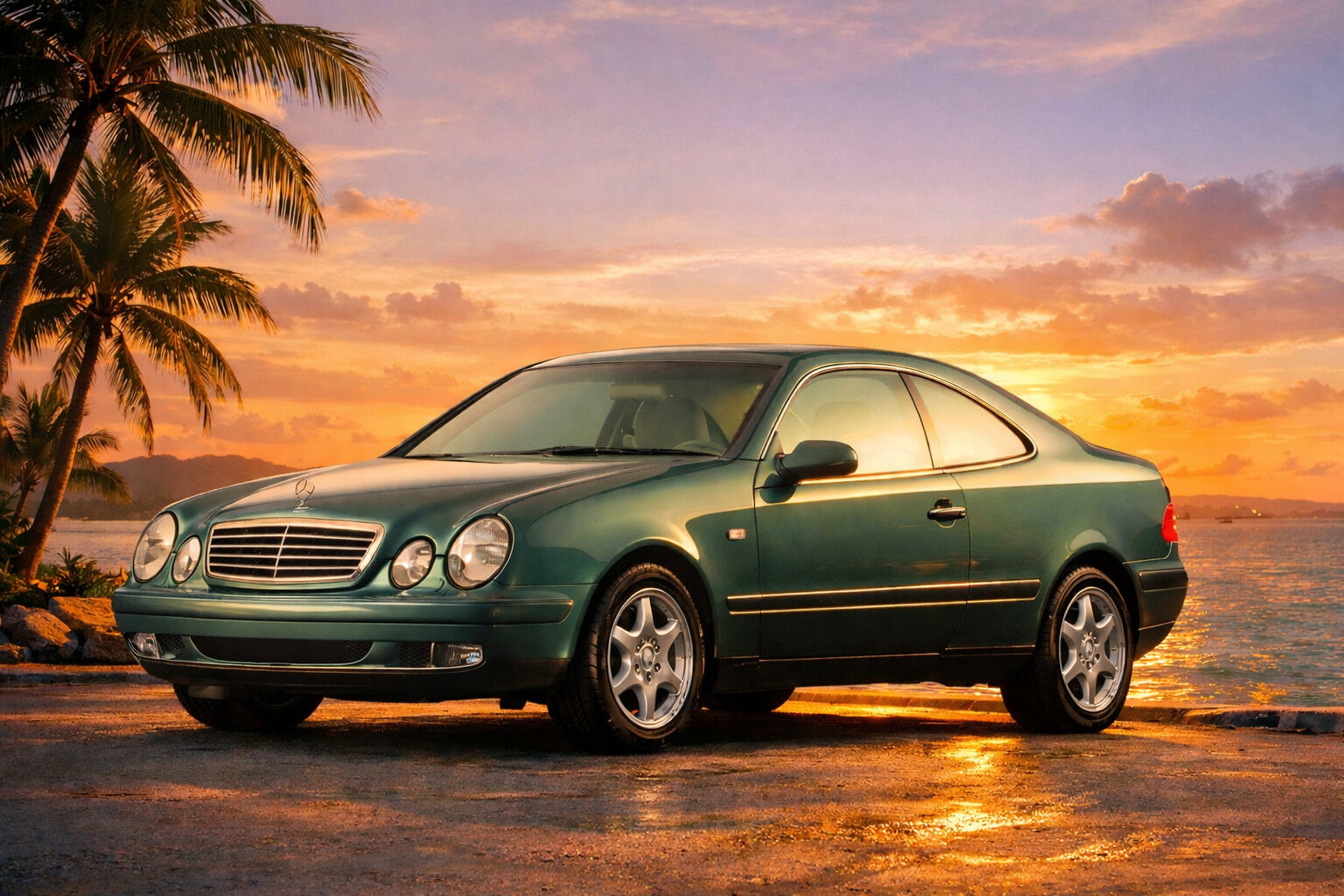
There is something deeply comic about being lectured on sustainability by a man financing his third battery-powered appliance on wheels while looking down his nose at an old Mercedes that has already outlived multiple governments and climate summits, and most of the moral fashions of the modern age.
Rowan Atkinson, to his credit, committed the small act of public heresy of saying out loud what many practical people have long suspected: that keeping an old car going can, in many cases, be more environmentally sensible than replacing it with a new electric or hybrid one simply because the zeitgeist demands it.
This is not the sort of opinion one is supposed to have.
Modern environmental virtue requires visible sacrifice, preferably financed at interest. It requires the consumer to present himself as morally upgraded through acquisition. The old creed said redemption came through restraint. The new creed says it comes through a fresh lease agreement and a charging cable.
But the arithmetic of machinery is not sentimental. Nor is it impressed by advertising.
A car is not only what comes out of its exhaust pipe. A car is the mine, the foundry, the plastics plant, the cargo ship, the robot arm, the paint booth, the marketing department, the dealer network, and the mountains of embedded energy required to produce it in the first place. Before a new EV or hybrid has rolled its first sanctimonious kilometre past a vegan café, an enormous environmental cost has already been incurred in manufacturing it.
That is where the old Mercedes enters the argument like a butler who has quietly watched three generations make fools of themselves.
Take the W124 300D. If ever there was a machine built with the assumption that civilisation should endure, this was it. It was engineered in that increasingly mythical era when Mercedes-Benz still seemed to believe that durability was not a marketing slogan but a moral duty. The doors shut with the tonal certainty of a bank vault. The switchgear operates with the calm precision of laboratory equipment. The seats feel less assembled than ordained. And the engine, especially in diesel form, was built not for a finance cycle, but for geologic time.
These cars were not optimised in the modern sense. They were overbuilt.
That word has fallen out of favour because it offends contemporary economics. Overbuilding means excess quality. It means parts designed to survive misuse, neglect, heat, cold, potholes, bad fuel, and human stupidity. It means steel where accountants later demanded plastic. It means mechanisms that can be repaired rather than modules that must be replaced. It means an object made with enough margin in it to endure.
And endure they did.
The W124 did not ask to be admired for its ethics. It simply went on existing. That, in itself, may be the most environmentally responsible thing a car can do.
Then there is the C208 CLK 320 coupé, one of the last Mercedes coupes to possess genuine elegance without trying too hard to explain itself. It belongs to that fading lineage of cars drawn by eye, proportion, instinct, and clay, not by committees staring at airflow simulations and trend reports about what urban confidence should look like in a crossover targeted at upper-middle management.
The C208 is from a period when cars still had silhouette. It is graceful without apology. Low, long-doored, composed, and quietly aristocratic, it understood that style need not shout. It did not need swollen wheel arches, fake diffusers, or a face like an angry vacuum cleaner to announce its relevance. It simply had presence.
And that matters, because beauty has a function.
People keep beautiful things.
They maintain them, repair them, shelter them, and refuse to throw them away at the first whiff of obsolescence. An elegant car that remains desirable for thirty years is doing something profoundly anti-disposable in a culture built on churn. A well-kept CLK 320 is not just a car; it is an argument against planned redundancy.
This is the part the modern car industry does not want discussed too loudly.
Because the business model of saving the planet increasingly resembles the old business model of selling you another product. The forms change. The righteousness intensifies. The debt remains. Every few years the public is informed that its current machines are no longer morally adequate. First the old petrol car was unacceptable. Then diesel became wicked. Then the hybrid was transitional. Now even some early EVs are beginning to look like disposable electronics with door handles. Tomorrow, no doubt, today’s solution will be denounced as embarrassingly primitive by the next generation of subsidised righteousness.
Meanwhile, somewhere under a carport, a W124 starts first turn and idles like a cathedral clock.
That is not nostalgia. It is material reality.
The truth buried beneath the slogans is that extending the life of a well-made object is often more sustainable than replacing it with a supposedly cleaner object whose entire existence depends on another cycle of extraction, manufacture, shipping, and eventual disposal. The greenest washing machine is often the one still washing. The greenest building is often the one already built. And yes, the greenest car may sometimes be the one already in your driveway.
This is not an argument against all electric vehicles. It is an argument against moral simplification.
There are sensible uses for EVs. Urban fleets, short predictable commutes, specific commercial applications, all fair enough. But the assumption that every old car is automatically an environmental sin while every new hybrid or EV is an ecological sacrament is childish. It mistakes visibility for virtue.
An old 300D, carefully maintained, sparingly used, and kept running for decades, may well represent a lower total environmental absurdity than a succession of fashionable green cars each requiring another round of industrial violence to produce.
And there is something else being lost in this debate, something no carbon spreadsheet quite captures.
The old Mercedes came from an era when industrial design still aspired to dignity. When dashboards were not giant illuminated tablets designed to distract and expire. When a coupé was not a bloated SUV with a sloping roof and an identity crisis. When designers sculpted cars in clay, tracing lines by hand and intuition, producing shapes that had humanity in them. Not perfect humanity perhaps, but humanity all the same.
Today much of the road is cluttered with finite-element-analysed anonymity: soft-edged hatchbacks, inflated crossovers, and identikit SUVs all converging toward the same aerodynamic loaf of caution. They are not designed to be remembered. They are designed to offend no focus group and to lease well for thirty-six months.
They are transport as software update.
By contrast, the W124 and the C208 belong to the last age in which a car could still possess character without becoming a cartoon. One was a monument to engineering seriousness. The other a masterclass in restrained beauty. Both were built in a civilisation that still believed permanence was a virtue rather than a market failure.
And perhaps that is the real scandal here.
Because once you admit that an old, durable, repairable, elegant machine may be greener than the latest sanctified consumer object, the entire moral theatre begins to wobble. The issue is no longer technology alone. It becomes culture. It becomes disposability. It becomes vanity. It becomes the uncomfortable possibility that the modern obsession with looking responsible may have less to do with stewardship than status.
That is why the old Mercedes is so subversive.
What if the answer was not more consumption, but less?
What if the planet was not saved by replacing reliable things with expensive new things, but by making good things last?
What if longevity, repairability, and beauty were not relics, but ecological virtues?
A W124 300D will never trend on social media as a lifestyle solution. A C208 CLK 320 coupé will not earn you applause from the electric clergy. Neither offers the instant moral cosmetics of a charging port and a government rebate.
But they do offer something far rarer.
They offer proof that the most responsible machine may be the one that was built properly in the first place.
And in an age of rolling battery packs, bloated SUVs, and eco-posturing financed over seven years, that old Mercedes parked quietly in the shade may be doing more for the planet than the entire sermon around it.