
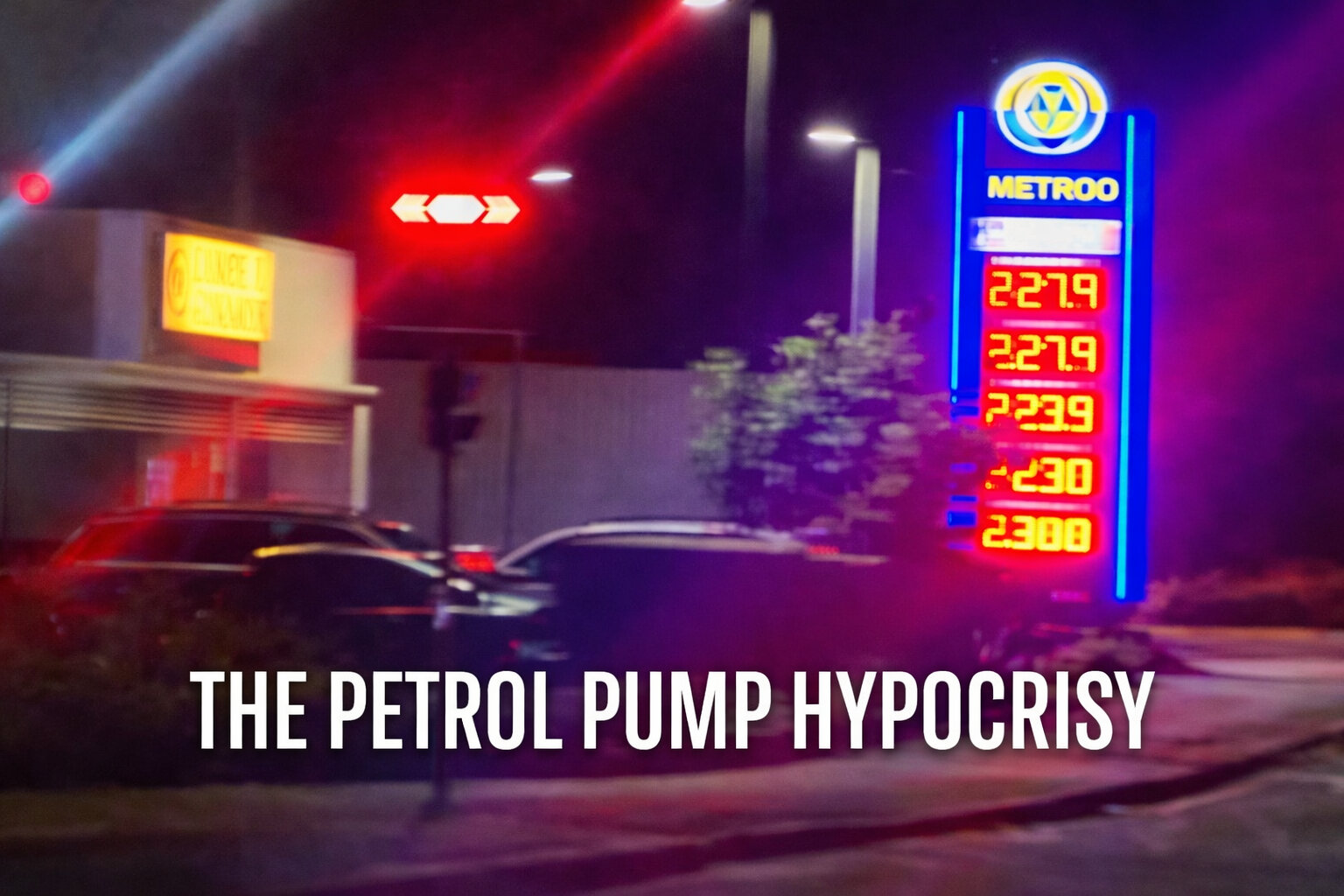
Three weeks ago, drivers on the Gold Coast could fill up for $1.49 per litre. Today the same bowser reads $2.27.
Nothing about the fuel in the underground tank has changed. The refinery has not suddenly become more expensive to operate. The truck that delivered the petrol did not run on champagne.
Yet the price has climbed nearly 80 cents a litre in less than a month.
And now the government announces — with theatrical sternness — that companies engaging in “price gouging” will face huge fines.
It sounds decisive. It sounds protective. It sounds like someone in Canberra is standing up for the consumer.
But the reality is closer to theatre than enforcement.
The Oil Companies Know the Game
Petrol retailers understand something very simple about regulatory threats: time is profit.
Investigations take months. Regulatory inquiries take years. Court cases take longer.
By the time any penalty is imposed — if one ever is — the price cycle will have turned over dozens of times.
In the meantime the margins are already banked.
A retailer who sells millions of litres during a spike can earn far more from the temporary surge than any eventual fine might cost. The penalty becomes just another operating expense — the price of doing business in a highly concentrated market.
So the announcement of “massive fines” lands not as a deterrent, but almost as background noise.
The Government’s Convenient Position
There is another awkward truth that rarely appears in the press conferences.
When the price of fuel rises, government revenue rises with it.
Australia’s fuel excise is a fixed number of cents per litre, indexed twice a year to inflation. When petrol prices surge, consumption often remains relatively stable — people still have to drive to work, transport goods still moves by truck — which means the tax keeps flowing.
But that is not the whole story.
Higher fuel prices also inflate GST receipts across the broader economy, because transport costs feed into the price of nearly everything that moves on wheels.
In other words, while motorists feel the pain at the pump, the treasury feels the benefit downstream.
Which makes the public outrage from government officials sound a little… selective.
The EV Nudge Nobody Mentions
There is also a political side-effect that suits government policy perfectly.
Every surge in petrol prices quietly nudges the public toward the officially preferred solution: electric vehicles.
When filling a petrol tank begins to feel like paying a utility bill, the pitch for EVs suddenly becomes easier.
The irony is that this shift conveniently replaces one perceived monopoly with another.
For decades motorists have complained about oil companies extracting profit from a captive population that needs to travel.
But once transport becomes fully electrified, the gatekeeper changes.
The energy comes from the grid — a heavily regulated system controlled by governments, utilities, and power markets.
Charging infrastructure, electricity pricing, and vehicle taxation all sit firmly within policy reach.
In other words, removing the oil companies from the equation does not eliminate the revenue stream.
It simply moves it.
From Petrol Pump to Power Socket
Governments already know that widespread EV adoption will eventually reduce fuel excise revenue — which is why discussions have begun about road-user charges and kilometre taxes for electric vehicles.
The logic is simple.
If motorists stop paying tax at the petrol pump, they will pay it somewhere else.
The power socket may yet prove to be the most efficient tax collector of all.
The Theatre of Enforcement
This produces the peculiar spectacle Australians now see:
- Oil companies push prices upward during the cycle.
- Government announces tough action.
- Investigations begin.
- Months pass.
- Prices fall again.
- The public forgets.
- The cycle repeats.
Everyone performs their role.
The oil companies harvest the spike.
The government harvests the headlines.
And the driver standing beside the bowser harvests the bill.
The Real Question
The real question is not whether price gouging exists. Anyone who watches the petrol cycle knows it does.
The real question is why the system tolerates it.
If a product can be sold profitably at $1.49 one month and $2.27 the next, then the difference is not economics.
It is market power.
And until that power is addressed — through real competition, transparent pricing, or structural reform — the ritual of outrage will continue.
The government will threaten.
The oil companies will smile politely.
And the numbers on the pump will keep spinning.