
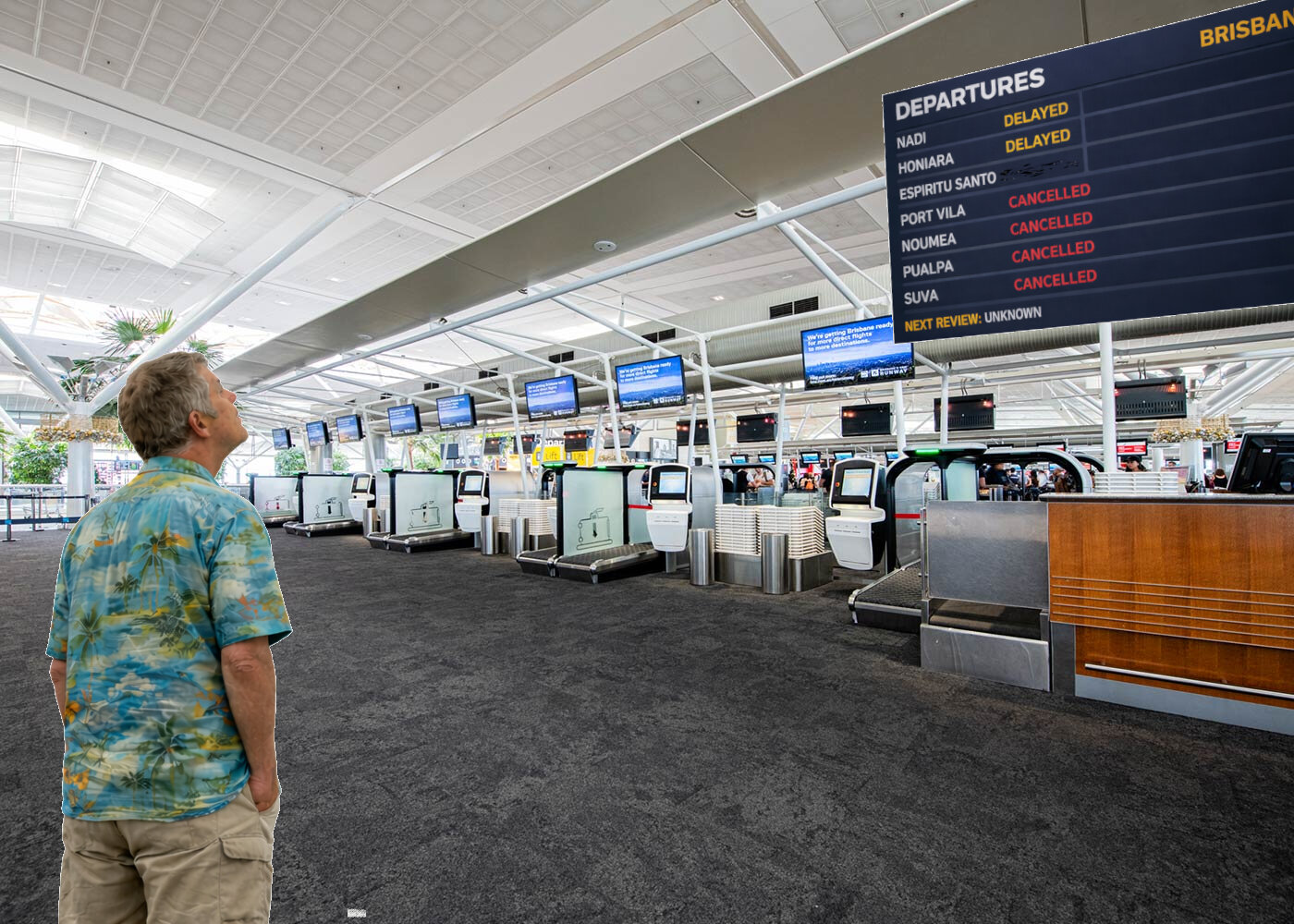
Every apocalypse fantasy begins with the same comforting assumption.
You’ll see it coming because you are awake.
There will be time to book the flight. Time to close the house. Time to slip quietly out of whatever large, complicated country you happen to be in and return to somewhere smaller, calmer, more human.
Somewhere like the islands of the Pacific.
It’s a common fantasy among people who have spent enough time in the region to understand its quiet strengths. Gardens instead of supermarkets. Fishing lines instead of logistics contracts. Communities that still function even when the wider system stumbles.
If the world ever lurched sideways, the logic was simple.
Take a relatively short plane ride.
Arrive before everyone else realises what’s happening.
That was the theory.
The problem with modern crises is that they don’t arrive like tropical cyclones.
They arrive like software failures.
Quietly.
Everywhere.
All at once.
The First Signal
The Iranian crisis did not begin with explosions on television.
It began with hesitation.
Insurance companies recalculating risk in the Strait of Hormuz. Tanker routes lengthening. Refineries bidding nervously for cargoes that suddenly looked uncertain. Freight markets tightening.
The first visible symptom wasn’t war.
It was mathematics.
Oil rose sharply. Jet fuel contracts became unpredictable. Airlines began quietly adjusting routes that had always lived on thin margins.
A few flights disappeared from the departure boards.
Nothing dramatic.
Just small operational adjustments.
The sort of thing travellers are used to ignoring.
The Airport
Airports are designed to project certainty.
Screens glowing with destinations. Announcements delivered in calm voices. People walking quickly because they believe the system is reliable.
But reliability is mostly a habit.
When aviation fuel tightens, that habit evaporates quickly.
Flights begin to consolidate.
Regional routes vanish first. They always do. Small markets are luxuries when fuel costs spike and insurers become nervous.
Then the map begins to shrink.
Brisbane to Port Vila only.
Sydney to Honiara.
Connections through Nadi.
A few cancellations become many. The Volcano is rumbling.
And suddenly the Pacific is still out there — exactly where it has always been — but the aircraft that once stitched it to Australia have begun to disappear.
The Coral Sea quietly becomes a moat again.
Not by policy.
By logistics.
Week Two: The Servo
The Australian version of the crisis arrives at the petrol station.
It always does.
First there are rumours from Western Australia about diesel allocations.
Then a refinery maintenance delay in Queensland.
Then freight companies quietly begin warning customers that transport costs are about to rise.
Soon the queues appear.
Australia has a long cultural memory of fuel queues, even if most of the population has never actually lived through them.
But memory travels through generations.
So when the government appears on television to assure the public there is no reason to panic-buy fuel, Australians interpret the message with admirable efficiency.
They panic-buy fuel.
Within days the signs appear.
LIMIT 40 LITRES
And suddenly the servo becomes the country’s most honest economic indicator.
The National Solution
This is where the story turns strange.
Because while oil has suddenly become scarce, something else is not.
Electric cars.
Thousands of them.
Warehouses full of gleaming Chinese-built EVs imported during the great electrification push, waiting patiently for a market transition that had been proceeding with predicatable social contagion.
Now the social itch becomes urgent.
Subsidies appear overnight.
Emergency rebates multiply.
Advertising campaigns urge Australians to “drive the future.”
The logic is elegant.
Petrol is scarce.
Electricity is abundant.
Therefore the problem solves itself. "Like you can charge your car oversight with solar panels on your roof." (quote: Australian PM).
The fact that the electrical grid is already performing acrobatics during heatwaves is a detail that can safely be discussed later.
Much later.
Preferably after the press conference.
The Sorcerer’s Apprentice
Watching the policy response unfold, one cannot help recalling an old story.
The Sorcerer’s Apprentice.
The wizard waves his arms and commands the system to behave.
The apprentice — in this case technology, bureaucracy, and algorithms — obediently begins fetching buckets of water.
Soon the house is flooding.
Everyone begins arguing about the correct regulatory framework for mops.
Fuel rationing arrives quietly.
Digital fuel credits.
Weekly allocations.
Priority access for agriculture, hospitals and emergency services.
Everyone else receives a polite message informing them of their new fuel allowance.
The tattooed generation — a civilisation raised on instant delivery and curated outrage — begins discovering something that previous generations understood instinctively.
Civilisation runs on diesel.
Not vibes.
Meanwhile, Somewhere Else
Across the Coral Sea the islands continue their quiet existence.
Gardens still grow.
Fish still swim.
Diesel generators still hum at the edge of villages where electricity has always been a negotiated luxury.
From a distance, the Pacific still looks like the sensible bolt-hole it has always been.
The place you would go if the wider machine began to malfunction.
The question, of course, is whether anyone who intended to go there actually made it in time.
Modern crises move very quickly.
Oil shock: days.
Airline routes cut: days.
Fuel rationing: weeks.
The window between “something seems wrong” and “the system is adjusting” is now measured in days rather than months.
The modern world is extremely efficient.
Which means when it stumbles, it does so very quickly.
And the difference between refuge and entrapment can be nothing more than a considered hestitation.