
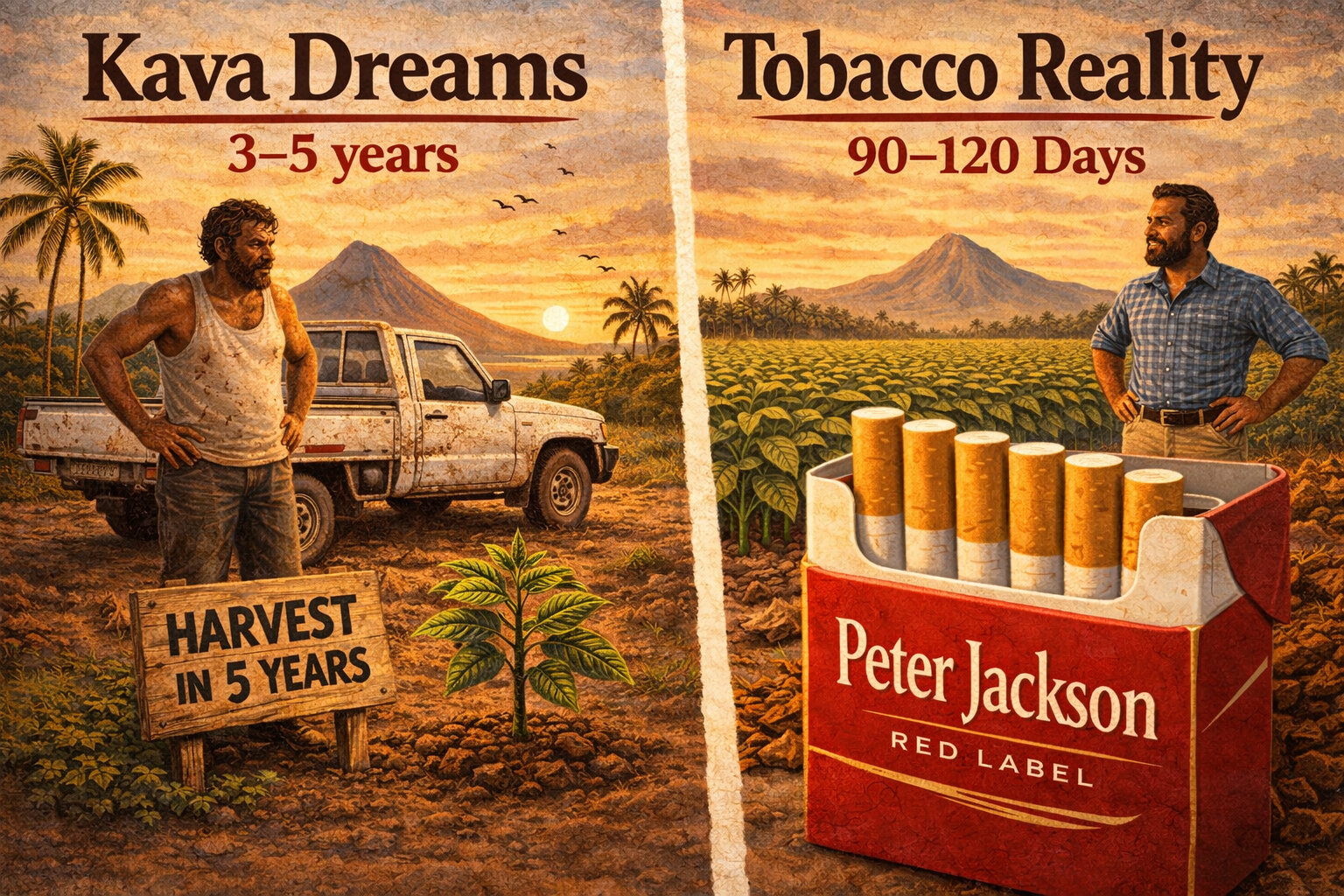
Romance is lovely. Agriculture, unfortunately, keeps its own books.
The Daily Post regularly applauds another entrepreneurial success as a farmer celebrates the purchase of a LandCruiser as the reward for five years of hard work as a kava cultivator. In the nakamals they cheer “green gold” and the dream of “exporting Vanuatu’s kava to the world.”
The language is always uplifting.
“Premium.”
“Organic.”
“Traditional.”
“Ancient Pacific wisdom in a shell.”
It sounds romantic.
Unfortunately, agriculture has a habit of ignoring romance and obeying mathematics instead.
And when you compare the economics of kava versus tobacco, the contrast becomes almost absurd.
The Five-Year Root
Kava is a remarkable plant.
In Vanuatu it is not simply a crop. It is culture, ceremony, conversation and evening ritual all wrapped into one muddy shell.
But as an export commodity, kava has one rather inconvenient characteristic:
it takes years to grow.
Typically:
- 3–5 years from planting to harvest
- careful cultivation required
- yields limited by climate and soil conditions
- bulky root systems that must be processed and dried
In other words, kava is the agricultural equivalent of a slow-cooked stew.
The real thing - freshly made kava from today's harvest, properly cleaned and blended with freshwater and filtered well - is nothing like the exported dusty dried roots of dubious origin or chalky 'instant' kava.
Hardly ideal for global commodity markets that move at the speed of shipping containers.
The One-Season Plant
Tobacco, by contrast, behaves very differently.
From planting to harvest:
90–120 days.
That means a farmer can produce multiple harvest cycles within the time it takes one kava plant to mature.
Even more inconvenient for policymakers:
- tobacco grows easily
- processing is straightforward
- storage and transport are efficient
- the final product has an enormous global market
Which explains why tobacco has been one of the most widely cultivated cash crops on Earth for centuries.
The plant obeys the most powerful rule of agriculture:
fast turnover equals reliable income.
The Market Reality
| Crop | Growth Cycle | Global Demand | Market Structure |
|---|---|---|---|
| Kava | 3–5 years | Niche, regulatory restrictions | Fragile export market |
| Tobacco | 3–4 months | Massive global demand | Entrenched supply chains |
Even more awkwardly for Vanuatu’s export ambitions, kava sits in a regulatory grey zone in many countries.
Some jurisdictions treat it like a herbal supplement. Others treat it like a potential narcotic. Some ban it outright.
So the country’s signature export product faces legal uncertainty before the container even reaches the dock.
The Policy Paradox
Meanwhile, halfway across the Coral Sea, Australia has inadvertently created one of the most profitable tobacco black markets in the world.
Cigarettes now sell for $40–$50 per pack.
Half the market is illegal.
Smuggling routes stretch across Asia.
Organised crime has built a multibillion-dollar underground industry supplying Australian smokers.
And here sits Vanuatu — fertile volcanic soil, agricultural labour, tropical growing conditions — trying to convince the world to drink a mildly sedating root beverage that takes half a decade to mature.
If one were designing export strategies based purely on economic logic, the contrast would be striking.
My Observation
Kava is cultural, it is social and it belongs to the Pacific in the pacific.
But the global marketplace does not reward poetry.
It rewards volume, speed and demand.
And while Vanuatu debates the marketing strategy for a plant that takes five years to grow and may or may not be legal in the destination country, the rest of the world is quietly proving a simpler agricultural truth:
the fastest-growing crop often wins the market.