
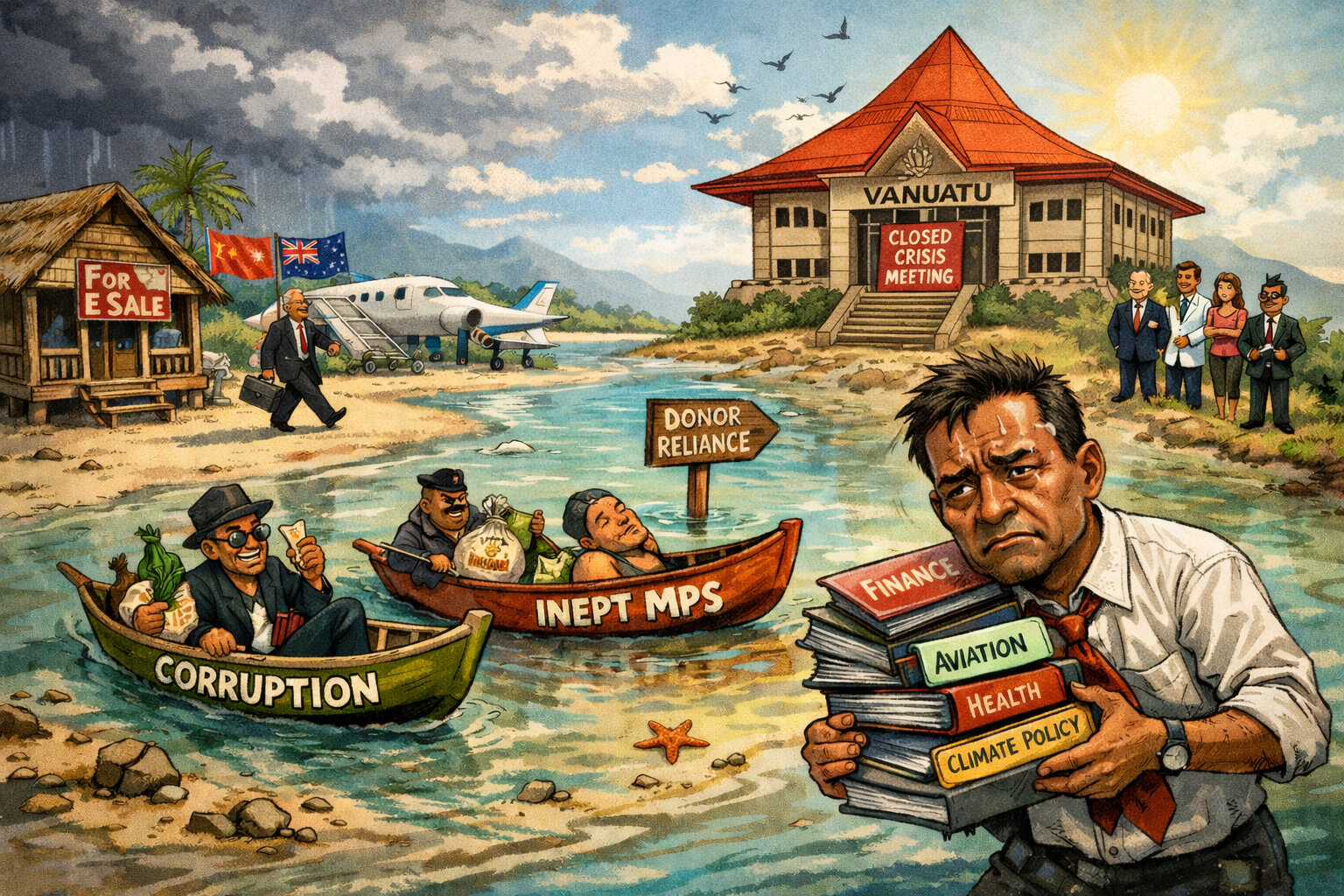
James Campbell’s provocation about Australia is amusing because it contains an uncomfortable grain of truth. A parliament of limited size inevitably narrows the talent pool. Cull the too old, the too green, the eccentric, the incompetent, the intoxicated and the unstable, and the ministerial bench begins to look less like a contest of brilliance and more like a default setting.
But Australia, for all its flaws, still operates within a deep reservoir of institutional memory, bureaucratic continuity and policy infrastructure.
Vanuatu does not have that luxury.
Vanuatu’s Parliament consists of 52 MPs representing just over 300,000 people scattered across 80 islands. On paper that sounds proportionate. In practice, once you subtract:
- The serial party-hoppers whose loyalty changes with the tide
- The illiterates who cannot meaningfully read the legislation they vote on
- The cunning tacticians who treat ministries as procurement platforms
- The corrupt operators who see public office as a dividend stream
- The well-meaning but administratively inept
- The absentee members who surface only when allowances are payable
…what remains is not a deep bench. It is a shallow lagoon at low tide.
And this is not merely a moral complaint. It is structural.
In a micro-state, politics is intensely personal. Family, church, wantok, land, and history all intertwine. The pool of eligible, capable, experienced leaders is not just numerically small — it is socially entangled. Everyone knows everyone. Accountability is softened by kinship. Rivalries are amplified by proximity.
Cull the inept, the stupid, the illiterate, the cunning and the corrupt — and you are left with a handful of serious, overburdened individuals attempting to manage aviation policy, telecommunications reform, biosecurity, climate financing, tourism recovery, and national debt negotiations — often simultaneously.
That is not governance. That is exhaustion.
The Illusion of Numbers
More MPs does not automatically equal better governance. Expand the chamber without reforming candidate standards, party discipline, education thresholds and conflict-of-interest enforcement, and you simply enlarge the problem.
Australia’s system works not because it has many MPs, but because it has:
- Strong party vetting mechanisms
- A professional public service
- Policy advisors who outnumber ministers
- Media scrutiny that is relentless
- An electorate that expects administrative competence
Vanuatu’s political culture remains transactional. Campaigns are personal, not ideological. Voters often reward immediacy over policy. Cash, roofing iron, school fees and funeral contributions win elections more reliably than legislative acumen.
In such an environment, increasing the number of MPs could simply increase the number of allowances.
The Harder Question
What Vanuatu truly needs is not more MPs.
It needs:
- Minimum literacy and governance competency requirements
- Mandatory public financial disclosure
- Clear separation between constituency funds and personal accounts
- Strengthened Ombudsman enforcement
- Serious civic education
Because here is the danger: when leadership quality is thin, the vacuum invites external dependency.
After Air Vanuatu’s collapse, we leaned on sister airlines. When budgets strain, we lean on donors. When expertise is lacking, consultants fly in. When policy falters, regional partners fill the gap.
A small parliament can work — if it is competent.
Singapore proves that.
But a small parliament riddled with instability becomes a revolving door of ministerial appointments. Ministries reshuffle faster than policy can settle. Each new appointee learns the portfolio just in time to lose it.
Continuity is the first casualty.
A Delicate Truth
Critiquing Vanuatu’s MPs is not fashionable locally. It is often labelled disrespectful or unpatriotic. But patriotism without accountability is theatre.