
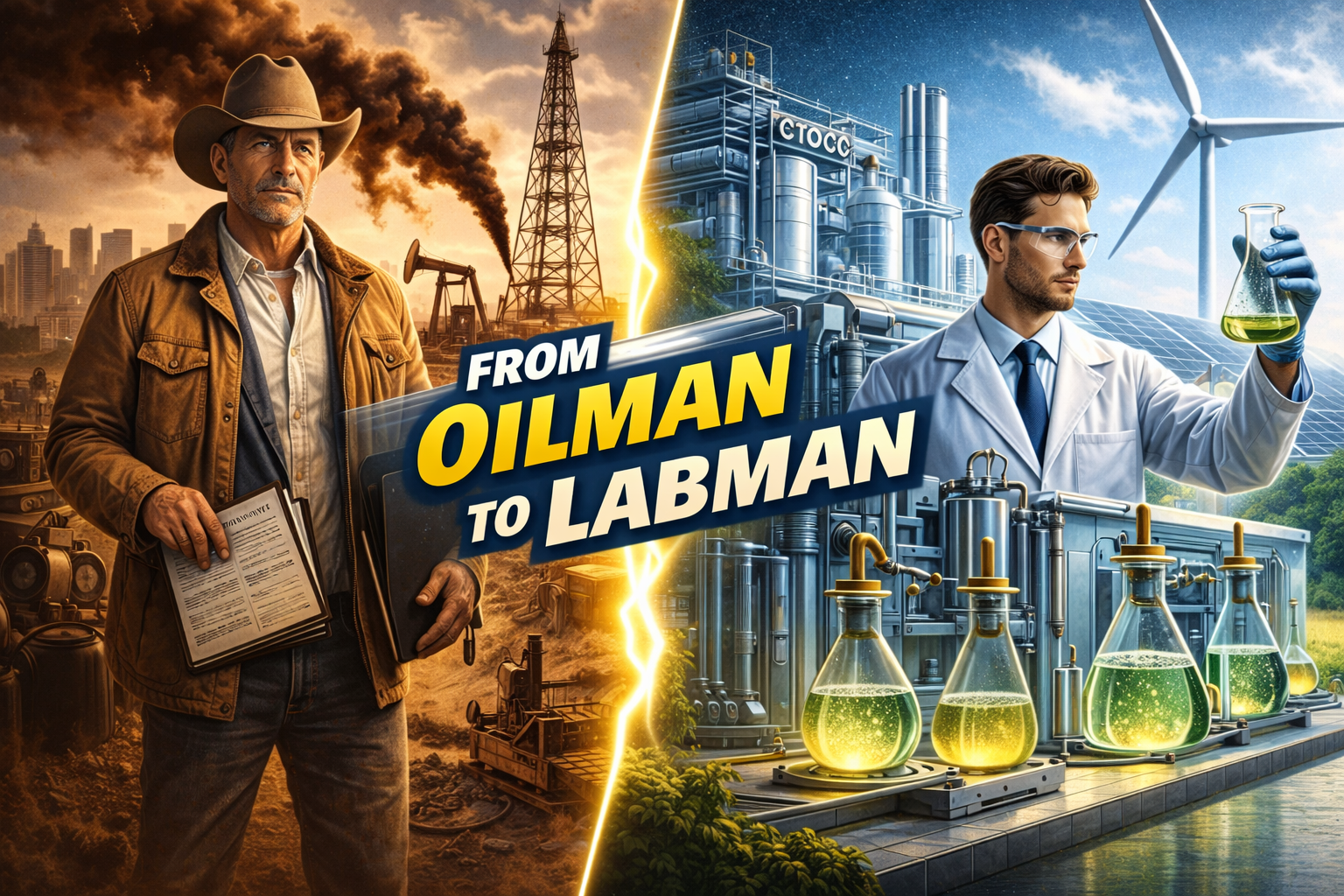
There was always a certain romance to the oilman — sunburnt, booted, deal sheet in hand, standing against a skyline of derricks and dust. It was an industry cast in grit and gamble, where fortunes were struck from the ground and lost just as quickly across a boardroom table. Characters like J.R. Ewing didn’t just dramatise it — they distilled it: charm wrapped around calculation, ambition sharpened by ruthlessness. Oil wasn’t just fuel; it was power, personality, theatre. The challenge now is altogether different. How do you make molecules — assembled quietly from air, water, and electricity — carry that same sense of scale, risk, and allure? How do you give synthesis the swagger of extraction?
The fuel debate is usually framed in moral terms — carbon bad, renewables good. But strip away the slogans and what remains is chemistry and economics. How we make fuel. Where we make it. And who benefits from it.
The Crude Reality
The fossil fuel industry is, quite literally, crude. We drill into the ground, extract a complex mixture of hydrocarbons, transport it across oceans, refine it in massive centralised plants, and then distribute it globally.
It is a system immortalised in popular culture — oil gushers, derricks, and sudden wealth. Think Beverly Hillbillies, where a lucky strike turns a backwoods family into millionaires. Or Dallas, where power and politics revolve around oil fields and control of supply.
And yes — Dynasty was the other one.
The fossil fuel industry is not just dirty in emissions — it is crude in structure.
The Chemistry We Ignore
Hydrocarbon fuels are not rare. They are simply molecules — chains of carbon and hydrogen.
Traditionally, we extract them from ancient biological deposits. But chemistry offers another path:
- Capture carbon dioxide from the air
- Split water into hydrogen
- Recombine them into synthetic hydrocarbons
The result is e-fuel — petrol or diesel that is chemically similar to fossil fuel, but manufactured rather than extracted.
It is, in effect, reversing combustion.
The Economic Equation
Today’s oil economy is built on distance and concentration:
- Extraction in one country
- Shipping across oceans
- Refining in another
- Distribution globally
Every step adds cost — not just financial, but geopolitical. Supply shocks, shipping risks, refining bottlenecks.
E-fuels invert this model.
Instead of moving fuel, we can move electrons — or better still, make fuel where we use it.
Electricity, water, and air exist everywhere. That means fuel production can be decentralised:
- Regional fuel plants
- Local energy independence
- Reduced transport costs
The Employment Shift
The fossil fuel model concentrates wealth and employment:
- Oil fields
- Refineries
- Shipping infrastructure
It creates hubs of activity surrounded by long supply chains.
A decentralised fuel system does the opposite.
It distributes employment:
- Small-scale production facilities
- Agricultural integration (bio-oils)
- Local maintenance and engineering
- Regional energy management
Instead of a few massive employers, you get many smaller ones. Less spectacle. More resilience.
Clean Chemistry, Cleaner Ethics
There is also a quieter distinction.
Fossil fuels rely on extraction — often in politically unstable regions, often tied to environmental degradation, often controlled by a small number of players.
Synthetic fuels rely on synthesis — controlled processes, predictable inputs, and potentially transparent supply chains.
Extraction concentrates power. Synthesis distributes it.
The Cost Question
Critics point to the current cost of e-fuels. And they are right — today, synthetic fuels are more expensive than crude oil.
But that comparison is static. It ignores:
- Volatility in oil markets
- Geopolitical risk premiums
- Transport and refining costs
- Environmental externalities
As renewable energy becomes cheaper, the input cost for e-fuels drops. As production scales, efficiency improves.
Meanwhile, crude oil does not get easier to extract. It gets harder.
Conclusion
The future of fuel is not a moral argument. It is a structural one.
We can continue to dig, ship, refine, and distribute — a system built for another century. Or we can build fuel from air, water, and energy, closer to where it is used.
From oil gushers and television fantasies to controlled chemistry and local production.
The shift is not from dirty to clean. It is from crude to precise.