
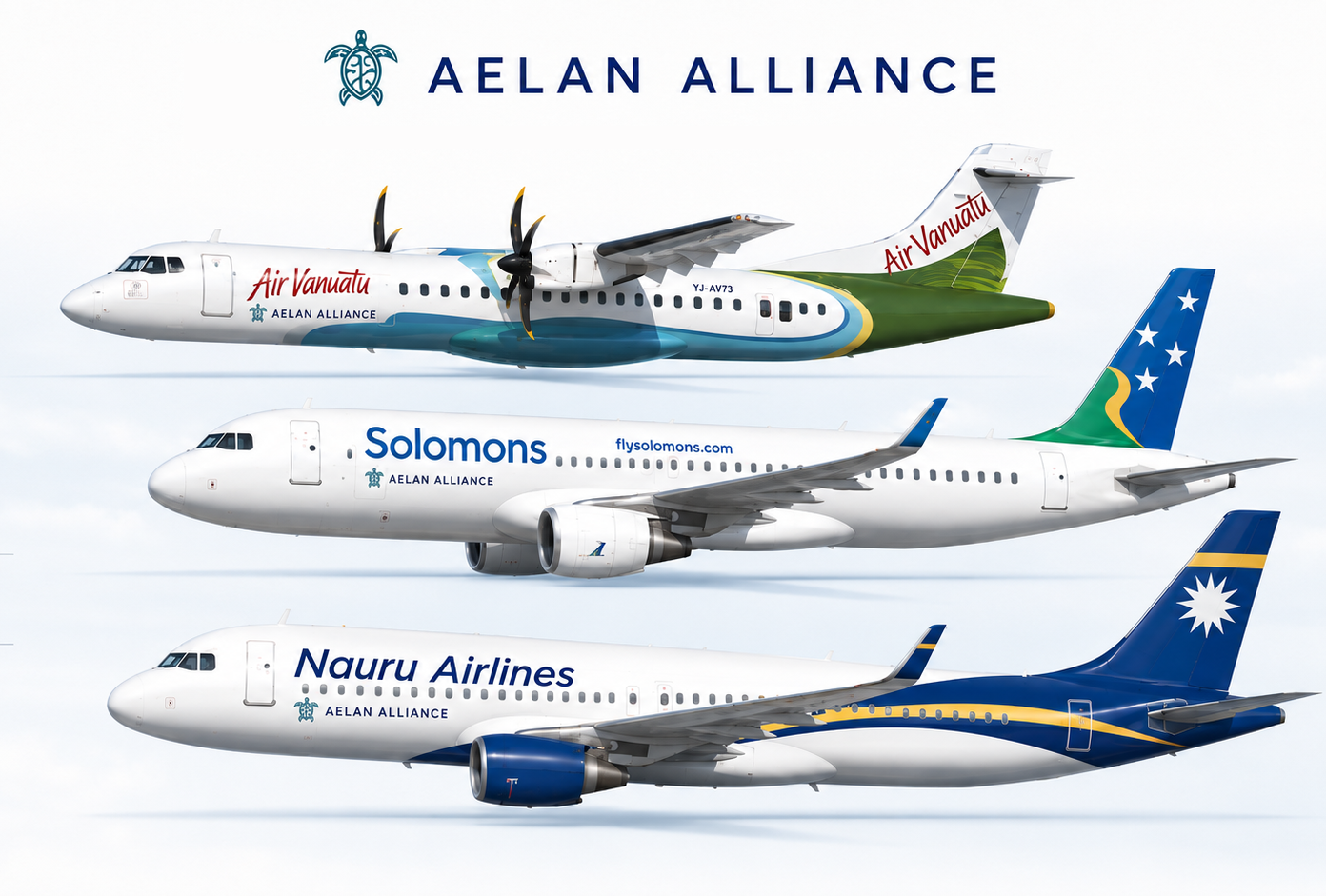
The Pacific once competed for travellers. Now it increasingly competes for aircraft capacity.
Pacific airlines have never been especially good at being friends.
That is understandable.
Most were born into a world where the scarce resource was the traveller.
There were only so many people wanting to fly between small island nations and Australia, New Zealand or Fiji, and every national carrier needed enough of them to justify its own routes, its own aircraft and, ultimately, its own existence.
So the culture became competitive.
Protect the route.
Protect the market.
Protect the passengers.
Protect the flag.
There was not much incentive for camaraderie.
But the problem may now be changing.
The Pacific is no longer quite so short of people wanting to travel.
What it is short of is reliable aircraft capacity.
That is a different problem.
And it may require a different way of thinking.
The Scarcity Has Moved
For years, an airline’s great anxiety was whether it could fill the seats.
Now, increasingly, the anxiety is whether there will be an aircraft to put the seats in.
Vanuatu knows that problem.
Solomon Islands knows it.
Kiribati knows it.
Nauru, despite having built a comparatively substantial operation, knows the difficulty of maintaining useful fleet depth in a small regional market.
One aircraft goes technical and the consequences can quickly spread far beyond the maintenance hangar.
Passengers are stranded.
Hotels lose bookings.
Freight is delayed.
Connections disappear.
A route that looked perfectly viable on paper suddenly ceases to exist for a few days.
And all this happens in a world that is not actually short of aircraft.
There are aircraft.
There are lessors.
There are operators.
There are crews.
There are engineering companies.
There are training organisations.
There are maintenance providers.
The world has aviation capacity.
The Pacific has trouble accessing enough of it, reliably and affordably.
That seems a more interesting problem than simply asking which airline needs another aircraft.
Perhaps the Airline Itself Is the Wrong Unit of Thought
We tend to think of an airline as one thing.
A company.
A CEO.
A fleet.
A reservations system.
Pilots.
Engineers.
Commercial people.
Training.
Freight.
Maintenance.
Safety.
Revenue management.
Network planning.
All wrapped together under one national brand.
But in practice, airlines stopped being truly self-contained a long time ago.
Aircraft are leased.
Heavy maintenance is outsourced.
Reservation systems are bought from global providers.
Training happens elsewhere.
Engines go overseas.
Wet-leased aircraft arrive with somebody else’s crew.
Consultants are brought in to help with fleet planning and restructuring.
The national airline is already assembled from pieces.
We simply continue to talk about it as if it were one indivisible machine.
In Computing, This Would Look Familiar
Modern software is rarely built from scratch as one enormous block.
It is built as a stack.
One layer handles data.
Another handles identity.
Another handles networking.
Another handles storage.
The application sits on top and uses those capabilities.
Nobody worries that every layer was not invented in the same building.
Perhaps Pacific aviation could be viewed in much the same way.
Aircraft access is one layer.
Engineering another.
Training another.
Reservations another.
Freight another.
Maintenance another.
Crew resources another.
Disruption recovery another.
Commercial systems another.
None of those capabilities necessarily has to be duplicated inside every small national carrier.
The airline people see — Air Vanuatu, Solomon Airlines, Nauru Airlines, Air Kiribati — could remain exactly that.
The interesting question is what sits underneath.
The Poisoned Chalice
This may also explain the remarkable turnover of airline chief executives across the region.
A new CEO arrives carrying an impressive aviation CV and is expected to fix everything.
Sometimes that person is local.
Often the person is recruited from overseas because the board believes the required experience does not exist internally.
Then they meet the organisation.
Tiny fleet.
Thin routes.
Government ownership.
Political expectations.
Expensive maintenance.
Staff loyalties.
National pride.
And the expectation that a commercially disciplined airline will somehow also behave as a public service whenever required.
For an outsider there can be another difficulty.
Formal authority does not always produce organisational acceptance.
The board may have appointed the CEO and government may support the appointment, yet parts of the organisation may still regard that person as somebody who does not quite belong.
That need not be overtly racial.
It may be cultural, nationalistic, personal or simply the understandable belief that somebody local should be running the national airline.
Resistance does not have to be dramatic to be effective.
Change slows.
Decisions are revisited.
Information moves imperfectly.
Eventually the CEO can find themselves responsible for rather more than they actually control.
Sometimes they are dismissed.
Quite often they simply leave.
Then somebody else is invited to take a sip from the same poisoned chalice.
The Frustration Cuts Both Ways
Local managers understandably watch that procession and wonder why outsiders keep being brought in.
Sometimes they may be perfectly capable of doing the job.
Sometimes they may not yet have the specialised international experience required.
But perhaps that argument also misses the point.
Why should one individual have to carry so much specialist capability in the first place?
Why should a national airline’s fortunes depend so heavily on finding one person with operational experience, commercial judgement, political skill, cultural sensitivity, fleet knowledge and extraordinary endurance?
A robust system ought to survive its CEO.
If it repeatedly does not, perhaps the organisation is asking too much of the person at the top.
The Pieces Are Already Scattered Around the Pacific
Nauru has built something useful around Brisbane.
Aircraft.
Crews.
Charter experience.
Freight.
Australian operating infrastructure.
Solomon Airlines has international operational experience and regional knowledge.
Kiribati has demonstrated an interesting separation between aircraft ownership and aircraft operation.
Vanuatu has demand, tourism, domestic requirements and a strong need for international connectivity, but little fleet depth of its own at present.
None of those is a complete solution.
That may be precisely why they are interesting together.
From Competition to Comparison
Historically these airlines had good reason to guard their ground.
The passenger was scarce.
One carrier’s gain could look very much like another carrier’s loss.
But if the present constraint is increasingly aircraft capacity rather than traveller demand, the relationship begins to look different.
Perhaps there is less value in asking:
How do we win passengers from each other?
And more value in asking:
What do you have that we need, and what do we have that you need?
That is a rather different conversation.
If one airline has access to aircraft capacity, another may have the route.
If one has engineering capability, another may have the demand.
If one has an Australian base, another may have freight.
If one can recover another’s disrupted passengers, everybody wins something.
Aelan Alliance
Perhaps that conversation deserves a name.
Aelan Alliance will do.
Not another airline.
Not a merger.
Simply a way for the existing airlines to start thinking about themselves less as isolated competitors and more as users of a common aviation stack.
The first useful step may be no more ambitious than comparing notes.
The people running these airlines already know where the pressure points are.
Aircraft availability.
Engineering.
Crews.
Freight.
Schedules.
Recovery when something goes wrong.
Put those people in the same room and ask what each airline has, what each lacks, and where cooperation might make life easier.
That sounds almost too simple.
Which may be why nobody has tried enough of it.
Separate Flags. Shared Capability.
There is no reason national identities need to disappear.
The flags can stay on the tails.
The brands can remain.
The cabin announcements can remain local.
The passengers may notice very little.
What could change is the machinery underneath.
Shared engineering.
Shared access to aircraft.
Shared training.
Shared recovery arrangements.
Shared freight capability.
Shared systems where it makes sense.
Not because cooperation is fashionable.
Because the scarcity has changed.
The Pacific once competed for travellers.
Now it increasingly competes for aircraft capacity.
And in a world full of aircraft, that ought to be a problem capable of a better solution.