
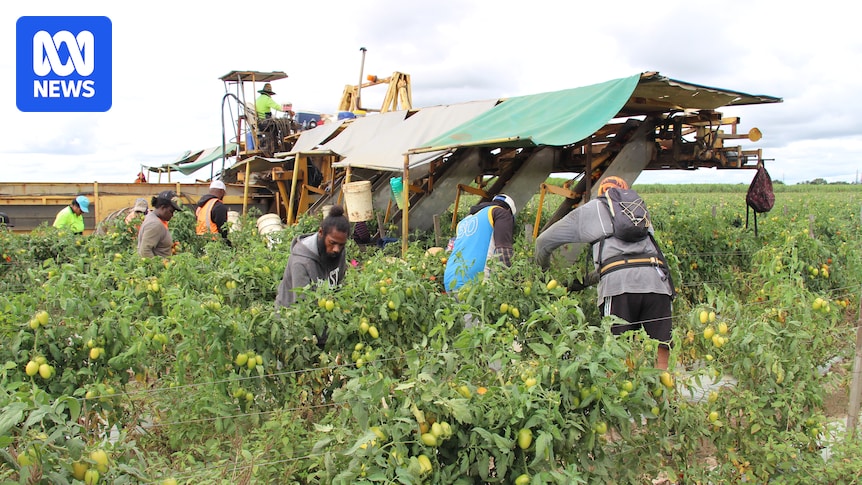
There are ghosts in Queensland’s cane fields.
They do not shout. They do not protest. They simply stand — silent reminders that this region once built fortunes on the backs of Pacific Island labour. In the 19th century it was called blackbirding: men taken or coerced from islands like Tanna, Santo and Malaita to cut cane in a land that was not theirs.
Today, the boats are replaced by jets. The contracts are signed, not shackled. The program has a logo, a website, and ministerial speeches invoking “family.”
Yet when you examine the numbers behind the Pacific Australia Labour Mobility scheme — PALM — a question lingers in the cane rows:
Who is really benefiting?
The Arithmetic of “Family”
We are told the scheme is a win–win.
Australia fills labour shortages in agriculture, meatworks, aged care and regional industries. Pacific nations receive remittances — money sent home by workers.
But according to data presented by DFAT in 2022, PALM workers generated roughly $990 million in economic value. Of that, about $184 million was saved or remitted to Pacific nations and Timor-Leste.
More than $800 million remained in Australia.
Eighty percent of the value created by workers from some of the poorest nations in the region stayed in one of the richest.
If that is family, it is a very one-sided inheritance.
The language is diplomatic. The arithmetic is colonial.
Modern Controls, Modern Constraints
The structure matters.
- PALM workers cannot easily change employers.
- They have no pathway to permanent residency.
- They cannot bring family.
- They can remain up to four years, but never belong.
- Employers and agents may deduct flights, visas, accommodation, transport and insurance. Workers are advised that perhaps one-third of their income may be saved or sent home.
This is not slavery. Let us be clear.
But it is a system of dependency carefully engineered to keep labour temporary, controlled and replaceable.
The NSW Anti-Slavery Commissioner and the UN Special Rapporteur have identified modern slavery risks within the scheme. Thousands have reportedly absconded from approved employers — a desperate gamble that tells its own story.
When a worker must choose between breaching visa conditions or enduring exploitation, something in the design is broken.
The Irony of Blackbirding
No one is being kidnapped.
And yet.
The historical irony is almost unbearable for those of us who call these islands home.
In the 1800s, labour was extracted from the Pacific to build Australian agriculture. The moral stain of blackbirding lingers in archives and apology statements.
Now, in the 21st century, labour is once again extracted — but with contracts, compliance regimes and development rhetoric.
The planes are chartered, the deductions itemised, the remittances celebrated in official media posts.
The mechanism is cleaner. The imbalance is not.
Australia is generous in many ways. It provides aid, disaster relief, scholarships, infrastructure and health support across the Pacific. But nowhere near the value PALM workers contribute to Australia’s economy directly and indirectly through taxes and spending.
When Santo families celebrate a son or daughter earning Australian dollars, they are proud. They endure long separations because remittances matter — for school fees, church roofs, tin sheets, solar panels.
Yet if 70–80% of the economic benefit of their labour remains offshore, we must ask whether development has quietly become subsidy.
Australia solves labour shortages.
The Pacific exports youth.
Communities lose working-age adults for years at a time.
And Canberra calls it partnership.
“Our Workers Are People, Not Commodities”
Vanuatu’s Labour Commissioner said it plainly: “Our workers are people, not commodities.”
That sentence should be engraved above every PALM contract.
Because this debate is not about whether the scheme should exist.
It is about:
- Fairer remittance outcomes.
- Greater worker mobility between employers.
- Stronger enforcement against exploitation.
- Genuine pathways for long-term contribution.
- Transparent accounting of who benefits — and how much.
If the scheme triples in size, as it has since 2022, then the moral weight triples with it.
Family or Feudalism?
Australia often speaks of the “Pacific family.”
Family implies reciprocity. It implies shared prosperity, not asymmetry disguised as opportunity.
A true partnership would ask:
- Why does 80% of value remain in Australia?
- Why are workers structurally temporary?
- Why are the poorest neighbours underwriting labour shortages in the richest country in the region?
We cannot rewrite history.
But we can refuse to repeat its patterns in softer tones.
Blackbirding was brutal and coercive. PALM is legal and voluntary.
Yet both systems revolve around the same axis:
Pacific labour powering Australian wealth.
And in the current debate on immigration there is an even greater irony: Australian tradie shortages and the housing crisis are being addressed by granting immigration status to hundreds of thousands of migrants, while PALM workers — who already fill labour gaps — remain structurally temporary and excluded from long-term belonging.